

One of the quieter lessons of recovery is learning that you are allowed to have limits.
For someone who has spent years trying to keep other people happy, avoid conflict, fix problems, or simply get through the day, setting a boundary can feel uncomfortable. Saying no may bring guilt. Asking for space may feel selfish. Choosing not to participate in something may feel like letting someone down.
But recovery is about more than changing a relationship with drugs or alcohol. It is also an opportunity to change the way we relate to ourselves and to the people around us. Sometimes, that begins with learning to say, This is what I need.
Addiction rarely exists in isolation. It can affect families, friendships, work, finances, responsibilities, and trust. Over time, people can become caught in patterns that are difficult for everyone involved. A person may become accustomed to hiding what is really happening. A family member may become accustomed to rescuing them. Friends may continue to invite them into situations that are no longer healthy. Someone in recovery may feel responsible for repairing every relationship and making everyone comfortable with the changes they are making.
Recovery can challenge all of those patterns.
Setting a boundary starts with an important question: What do I need in order to protect my recovery and my well-being?
The answer will look different for everyone. For one person, it might mean declining an invitation to a party where alcohol will be present. For another, it might mean asking a family member to stop bringing up painful events during every conversation. Someone else may need to create distance from a relationship that repeatedly pulls them toward unhealthy patterns.
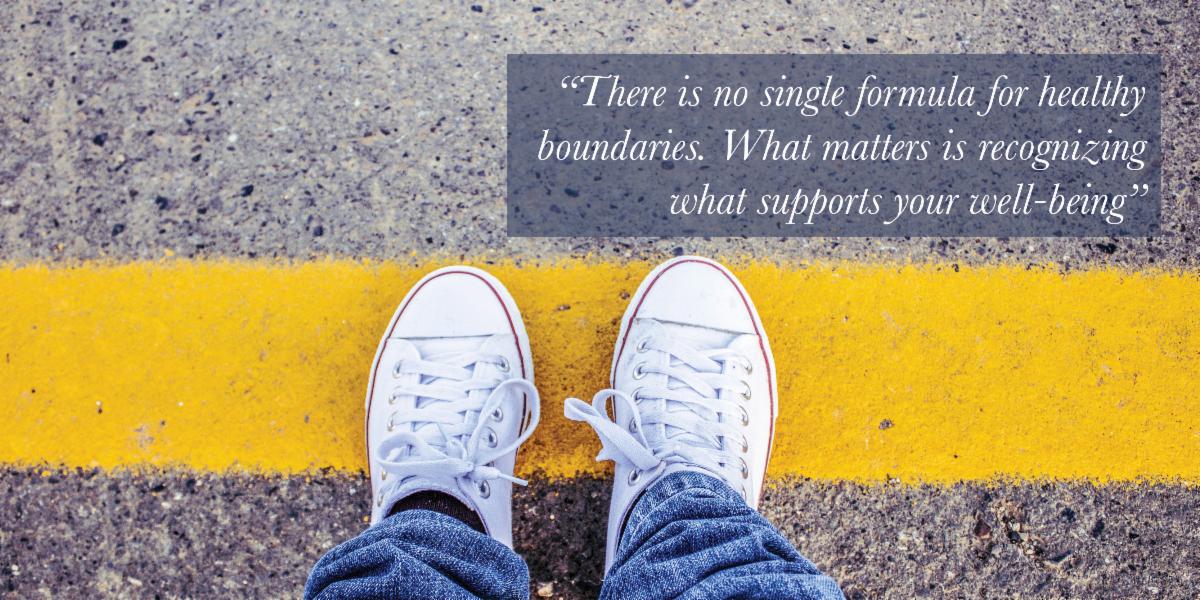
There is no single formula for healthy boundaries. What matters is recognizing what supports your well-being and having the courage to communicate it.
One reason boundaries can be difficult is that they can feel like rejection. But having a boundary does not mean that you care less. Sometimes, the opposite is true. A person may set a boundary because they want a relationship to survive. They may need to change the way they interact with someone because the old pattern was damaging to both people.
There is a difference between saying, I don’t want to talk to you, and saying, I want to have this conversation, but I need us to speak respectfully to each other. The second statement does not close the door. It explains what is needed to keep the door open.
Healthy boundaries can create room for healthier relationships.
For many people, one of the hardest boundaries is simply saying no. Some feel they need a long explanation before turning down an invitation. Others apologize repeatedly for protecting their time, energy, or recovery.
But no does not always need a lengthy explanation.
I can’t make it tonight.
I’m not comfortable with that.
That doesn’t work for me.
I need some time to think about it.
These can be complete sentences.
For someone in recovery, learning to say no can be an important shift. It is not necessarily being difficult or selfish. It can be an act of self-awareness and self-protection.
There will be times when someone else does not understand a decision you make to protect your recovery. That does not automatically make the boundary wrong.
It is also important to remember that boundaries are about what we will do, not about controlling what someone else does.
For example, saying, I am not going to stay somewhere that people are using substances, is a boundary. It focuses on your own actions. Saying, You are not allowed to use substances around me, attempts to control another person’s behavior.
The same principle can be helpful for families. A parent might say, I love you, but I will not give you money if I believe it will support your substance use. That does not mean the parent has stopped caring. It means they have recognized something they can control: their own actions.
This can be difficult for people who have spent a long time trying to help someone they love. But recognizing what we can and cannot control can relieve some of the pressure that often surrounds addiction.
Guilt can be one of the biggest obstacles to setting healthy boundaries.
A person in recovery may feel guilty for putting themselves first after years of hurting others. A family member may feel guilty for stepping back after years of trying to help. A loved one may worry that setting a limit means they are abandoning someone they care about.
But guilt does not always mean that we have done something wrong.
Sometimes, guilt simply means that we are doing something unfamiliar.
If someone has spent years saying yes, their first healthy no may feel incredibly uncomfortable. That discomfort does not necessarily mean they should take the boundary back.
With time, people can learn that caring for themselves and caring about other people do not have to be opposing choices.
Boundaries are also not just something we announce. They are something we practice.
At the same time, boundaries can change. Early recovery may require more structure or distance from certain situations. As a person’s recovery develops, their needs may change too.
Someone who once needed to avoid a particular environment may eventually feel comfortable returning to it. Someone may decide that a relationship can continue with different expectations. Someone else may discover that more distance is necessary than they originally thought.
Changing a boundary is not automatically a setback. It can simply be an opportunity to ask, What do I need now?
Recovery is a process of learning. As people learn more about themselves, their boundaries may evolve too.
And while we often think of boundaries as something we set with other people, recovery can also involve developing boundaries with ourselves.
Can I recognize when I am overwhelmed before I reach a breaking point?
Can I give myself permission to rest?
Can I walk away from a situation I know is unhealthy?
Can I keep the commitments I make to myself?
Can I stop treating one difficult day as evidence that everything is falling apart?
These questions matter because recovery is not simply about avoiding substances. It is about developing a life that is sustainable, meaningful, and worth protecting.
There is something powerful about knowing where you stand. Not because you have every answer, and not because you can control what happens around you, but because you begin to understand yourself.
You learn that you can disappoint someone and still be a good person. You discover that saying no does not automatically make you selfish. You realize that caring about someone does not mean taking responsibility for everything they do.
Most importantly, you begin to understand that protecting your recovery is not something you need to apologize for.
A boundary can be as simple as saying, I can’t do that.
It can also be as brave as saying, I need something different.
For many people, learning to say those words is not the end of a relationship.
It is the beginning of a healthier one.
And sometimes, it is the beginning of a healthier relationship with yourself.